
How to Calculate Chronological Age
Last verified: September 2026 · Free 5-step borrowing method
Learn how to calculate chronological age by lining up the target date over the birth date, then subtracting days, months, and years. When a column is too small, borrow from the next bigger unit — the same idea as elementary subtraction, applied to calendars.
Verify after you learn how to calculate chronological age
Practice the five steps below, then double-check with the free chronological age calculator. Publisher rounding lives on the test age calculator.
How to calculate chronological age: overview
Knowing how to calculate chronological age is a core skill for clinicians, teachers, and anyone who fills age fields on forms. Chronological age is calendar time from date of birth to a target date — usually a testing session, not “today” by accident.
This guide teaches how to calculate chronological age by hand with the borrowing method, then shows how tools, Excel, and publisher rounding fit on top. You will finish with five clear steps you can repeat on any pair of dates.
Whether you are a psych intern, an SLP student, or a parent checking school paperwork, the borrowing method correctly prevents silent scoring and eligibility errors.
What you need before how to calculate chronological age
Gather two dates: date of birth and target date. For assessments, the target is the administration date. For “how old am I,” the target is today. Without both dates, manual calculation cannot start.
Prefer verified DOB sources. A one-day DOB error changes leftover days and can flip clinical rounding. computing chronological age is only as accurate as the inputs.
Optional tools: paper and pencil for practice, then ChronoCalc to verify. External practice standards for SLPs appear on asha.org; child development context is available from the CDC.



How to calculate chronological age in 5 free steps
Here is the complete sequence for manual age calculation manually. Memorize the order: days first, then months, then years.
Step 1 — Line up the dates
Write the target date on top and the birth date underneath, aligned as year | month | day. This layout is the starting point for hand calculation on paper without a spreadsheet.
Step 2 — Subtract days
Subtract the birth day from the target day. If you can, record the leftover days. If not, borrow one month from the target month and add that month’s day count to the target day, then subtract. This borrow is the heart of the five-step method when dates do not line up neatly.
Step 3 — Subtract months
Subtract the birth month from the (possibly reduced) target month. If months go negative, borrow one year — add 12 months to the month column and reduce the year by one. Continue hand calculation only after months are non-negative.
Step 4 — Subtract years
Subtract the birth year from the adjusted target year. That difference is the years component. You now have years, months, and days — the full answer for finding years months and days exactly.
Step 5 — Format and (optionally) round
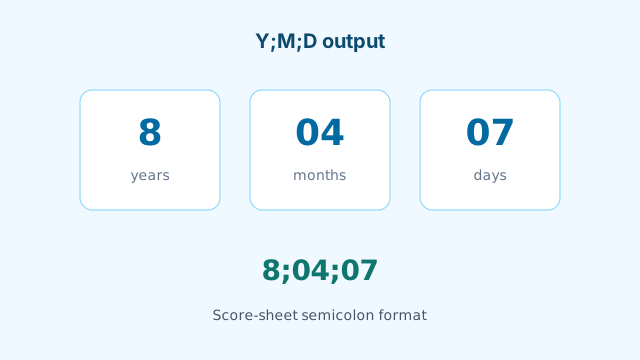
Write the result as years, months, and days, or as Y;M;D for score sheets. Apply publisher rounding only after you know working the date subtraction without rounding. Never round first and then pretend the exact age never existed.
Easy example: how to calculate chronological age without borrowing
Born March 15, 2018. Target June 20, 2026. Days: 20 − 15 = 5. Months: 6 − 3 = 3. Years: 2026 − 2018 = 8. Age = 8 years, 3 months, 5 days. That is calendar age math when every column subtracts cleanly.
Verify the same pair on the homepage calculator. Matching results builds confidence that computing chronological age on paper agrees with software.
Hard example: how to calculate chronological age with borrowing
Born November 28, 2014. Target January 15, 2026. Days: 15 − 28 fails. December has 31 days, so borrow: 15 + 31 = 46; month becomes 0 (January reduced). Days: 46 − 28 = 18.
Months: 0 − 11 fails. Borrow a year: year 2026 → 2025, month 0 → 12. Months: 12 − 11 = 1. Years: 2025 − 2014 = 11. Age = 11 years, 1 month, 18 days. This is the classic the borrowing method borrow pattern.
Re-run the example yourself. Speed comes from repetition; accuracy comes from always borrowing real month lengths when you practice the five-step method.
Why how to calculate chronological age needs months and days
Years alone hide whether someone is 8;00;01 or 8;11;28. Norm tables and school cutoffs often care about leftover months. manual age calculation in three parts prevents picking the wrong age band.
Legal age (turning 18) can also depend on the exact anniversary. Learning hand calculation to the day matters outside clinics too.
Cumulative months (for example 99 months) is the same span counted differently. After you know the five-step method in Y;M;D, converting to total months is multiplication and addition — not a new calendar system.
Leap years when you learn how to calculate chronological age
February has 28 days in common years and 29 in leap years. finding years months and days across February must use the actual length of the month you borrow from — never a fictional always-30.
Leap-day births (February 29) need a written policy for non-leap years (often February 28 or March 1 depending on protocol). Check the manual after you finish working the date subtraction for the raw span.
ChronoCalc’s engine documents leap handling on methodology. Use that page when software and a classmate disagree about date subtraction near February 29.
Month-end birthdays and how to calculate chronological age
Born on the 31st? Not every month has a 31st. When borrowing, add the true day count of the previous month. That detail separates correct calendar age math from approximate “30-day month” classroom shortcuts.
Some SLP courses still teach 30-day months for speed. That convention can disagree with calendar borrowing. Know which rule your supervisor wants before you decide computing chronological age for a graded case.
Our ASHA-style borrowing article explains the 30-day teaching method. This page remains the primary the borrowing method guide for real calendar lengths.
Rounding after how to calculate chronological age
Publishers disagree. Pearson / Wechsler often round to the nearest month (days ≥ 16 up). Super Duper tools often floor to the completed month. CELF-style sheets usually keep exact days. Always compute exact age first — that is manual age calculation — then apply the manual.
Mixing rounding rules across a multi-test battery is a frequent error. Document which rule you used after hand calculation for the shared testing date.
Use the test age calculator for publisher modes once you can explain calendar age math without software.
Excel after how to calculate chronological age
Spreadsheets help when you already understand the five-step method. DATEDIF can return years, months, and days for bulk caseloads. Formulas fail silently on blank cells — review outputs.
Follow the dedicated Excel age calculator guide for copy-paste formulas. Treat Excel as verification, not as a replacement for knowing finding years months and days on a single case in supervision.
Pivot tables and caseload trackers should store DOB and testing date separately. Recompute when either changes. Cached ages go stale; working the date subtraction is always date-pair specific.
Clinical workflow: how to calculate chronological age on eval day
Before the session, confirm DOB in the chart. After the session, lock the testing date. Then calendar age math for that pair — manually or with ChronoCalc — before raw-score conversion begins.
If a report is written days later, do not re-run computing chronological age with “today.” Keep the administration date. Birthday crossings between session and write-up are a classic trap.
Supervisors can ask trainees to show paper steps for one case per week. Teaching the borrowing method aloud surfaces mistakes faster than staring at a finished Y;M;D line.
Common mistakes in how to calculate chronological age
- Using report date instead of testing date
- Borrowing 30 days every time regardless of month length
- Rounding before recording exact age
- Transposing month and day in international date formats
- Forgetting to carry when months round from 11 to 12
Each mistake changes scores or eligibility. A short checklist after the borrowing method catches most of them in under a minute.
When two tools disagree, recompute by hand. Disagreement is a gift — it forces you to re-examine manual age calculation instead of trusting the louder screen.
Practice set: how to calculate chronological age
Try these pairs, then verify online. Practicing hand calculation with mixed borrowing builds speed.
- DOB 2019-04-10 · Target 2026-04-10 → exact anniversary (years only, 0 months, 0 days).
- DOB 2016-08-31 · Target 2025-09-15 → month-end borrow practice.
- DOB 2012-02-29 · Target 2025-03-01 → leap-day policy discussion after the five-step method.
Write full Y;M;D answers. Then open the chronological age calculator and compare. Mismatches mean revisit the borrow steps for finding years months and days — do not “fix” the paper until you find the error.
Related resources after how to calculate chronological age
Continue with methodology, the Excel guide, and publisher tools via the test age calculator. Each assumes you already know working the date subtraction at the calendar layer.
For professional context, browse ASHA and CDC resources. They do not replace local manuals, but they situate calendar age math inside broader clinical practice.
Teaching the borrowing method in class
Instructors can project one easy pair and one hard pair, then ask students to shout the borrow decisions before revealing the answer. Public reasoning reduces the silent error of copying a neighbor’s final Y;M;D without understanding.
Grade the process, not only the final age. A correct answer with an illegal 30-day borrow every month may pass a rushed quiz and fail a clinic competency check later.
Pair students to audit each other’s scrap paper. Peer review catches off-by-one month mistakes cheaper than waiting for a supervisor on externship.
End each lab by verifying with ChronoCalc. Software confirmation after honest paper work builds trust without creating dependency.
International date formats and transcription risk
Day-month-year versus month-day-year confusion flips ages dramatically. Always label forms with an unambiguous format such as YYYY-MM-DD when teams span countries or software locales.
Electronic health records may display dates in the viewer’s locale while storing ISO underneath. Confirm the numeric day and month against a written source before subtracting.
When reading a faxed birth certificate, watch for smudged digits. A 3 that looks like an 8 is a multi-year disaster if unnoticed.
For telehealth intakes, ask caregivers to hold the birth record to the camera rather than relying on memory of “sometime in March.”
School timelines and why exact age still matters
Kindergarten cutoff dates, preschool eligibility windows, and transition-from-Part-C timelines all lean on calendar age. An off-by-one-month error can move a child across a policy line.
Multidisciplinary teams should share one computed age for the evaluation window. Conflicting ages across psychology, speech, and OT sections undermine credibility at the IEP table.
When re-evaluations are due on a legal anniversary, recompute rather than adding twelve months to last year’s figure. Leap years and prior rounding make naive addition unsafe.
Archive the age printout with the signed evaluation. Future auditors appreciate seeing the same numbers the team used.
Mental math shortcuts — and when to avoid them
Counting whole years on your fingers is fine for conversation. It is not fine for norm tables. Shortcuts that ignore leftover months create the exact errors this guide exists to prevent.
If you must estimate quickly in a hallway consult, say you are estimating and recompute formally before scoring. Labels matter.
Some clinicians convert everything to total days, subtract, then rebuild years months days. That method works if day-count code is correct; it is harder to hand-check without a tool.
Pick one defensible method and stay consistent across a caseload. Consistency makes peer review possible.
Quality-review checklist for clinics
Spot-check 10% of files quarterly: DOB source, testing date, written age, and whether rounding matched the publisher. Publish the error rate so staff see the stakes.
New hires shadow an experienced clinician through one full age computation before independent scoring privileges. Competency is faster to train than reputation is to repair.
Celebrate near-misses reported by staff. A culture that hides age mistakes guarantees those mistakes reach families.
Revisit the checklist whenever your clinic adds a new publisher or digital scoring portal. New UIs introduce new default-date traps.
One-page job aid for how to calculate chronological age
Print a one-page job aid that restates how to calculate chronological age in five lines: align dates, subtract days with real borrows, subtract months, subtract years, format then round only if the manual says so. Tape it above the scoring desk.
New staff should complete three supervised cases using the job aid before independent work. That onboarding step embeds how to calculate chronological age faster than a long lecture alone.
Update the job aid when your clinic adopts a new publisher rounding rule. The calendar steps for how to calculate chronological age stay stable; the final format line may change.
Laminate a second copy for the student workroom. Shared physical reminders keep how to calculate chronological age visible during busy evaluation weeks.
Summary: how to calculate chronological age
How to calculate chronological age: align target over birth, subtract days, months, and years, and borrow with real month lengths when needed. Format as years/months/days or Y;M;D, then apply publisher rounding only if required.
Practice until the five steps are automatic. Use ChronoCalc to verify, keep manuals nearby, and treat every how to calculate chronological age result as a checkable clinical step — not a guess.