
Leap Year Age Calculation: 6 Clear Rules for Leaplings
Table of Contents ▼
One of the most fascinating quirks of the Gregorian calendar is the existence of Leap Day. But for people born on February 29th (affectionately known as “leaplings”), determining exactly when to celebrate their birthday—and legally, when they age—can be surprisingly complex. Understanding leap year age calculation requires a look at both astronomy and legal statutes. (You can read more about leap years on Wikipedia).
Table of Contents
The Astronomical Reason for Leap Years
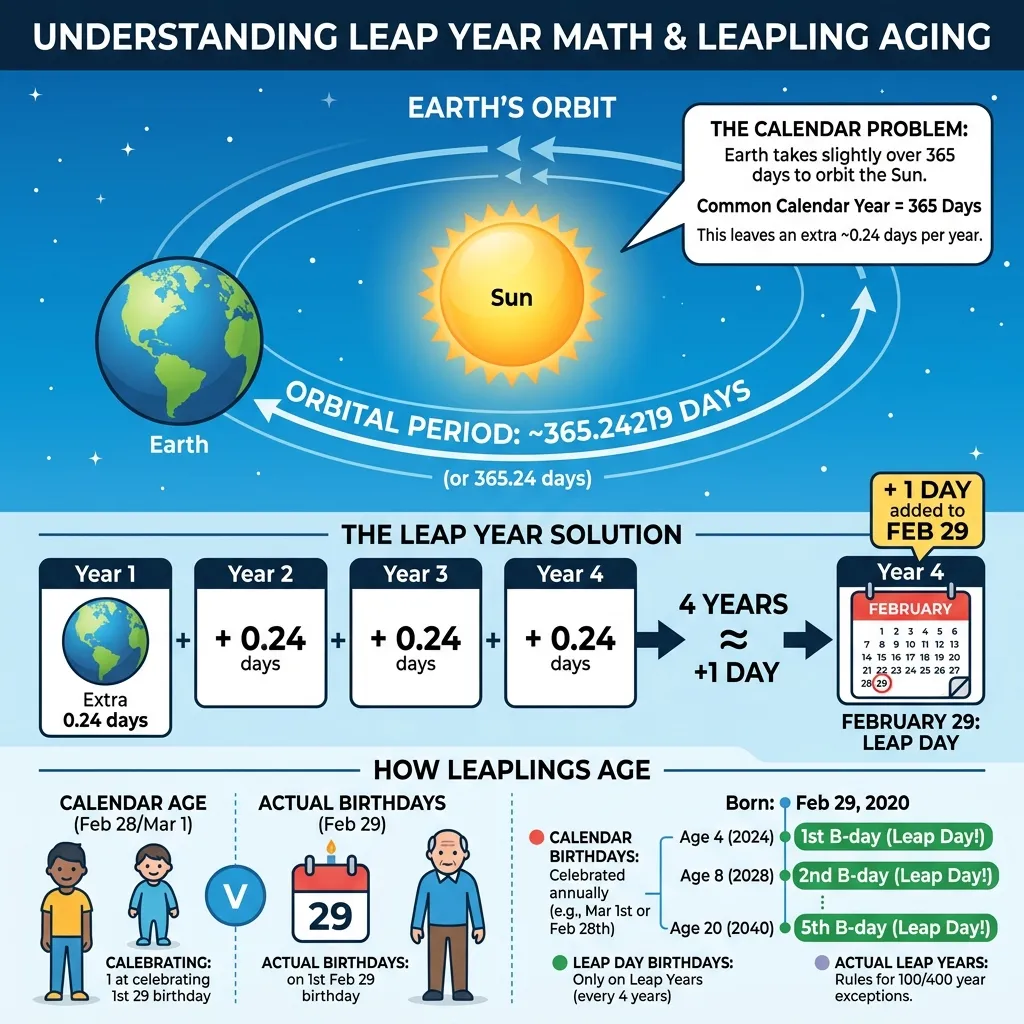
To understand the calculation, we must first understand the astronomy. The Earth does not take exactly 365 days to orbit the sun; it actually takes approximately 365.24219 days. If we didn’t account for this extra quarter of a day, our calendar would eventually drift completely out of sync with the seasons. To correct this, we add one extra day—February 29th—to the calendar nearly every four years.
How Leaplings Legally Age
The biggest question for someone born on February 29th is: when do they legally age during a common year (a year with only 28 days in February)? The answer depends entirely on local jurisdiction.
In many countries, including the United Kingdom and Hong Kong, the law explicitly states that a person born on February 29th legally reaches their next age on March 1st in non-leap years. Conversely, in places like New Zealand and Taiwan, the legal aging date is set to February 28th. In the United States, there is no overarching federal statute, so it varies by state, though most states (and insurance companies) default to March 1st.

Common vs Non-Common Years
When performing historical or demographic data analysis, leaplings introduce a margin of error. If you are calculating the exact age of a person in days, you must account for the specific number of leap years they have lived through. This is why standard age calculators often fail to provide pinpoint accuracy.
Calculating Exact Age
To avoid the confusion of shifting legal dates, professionals use highly specific algorithms that calculate age based on the exact number of days elapsed since birth. If you want to see exactly how many days old you are, taking every leap year into account, you can use our precise chronological age calculator to get an exact mathematical breakdown, completely bypassing the February 28/March 1 debate.
Frequently Asked Questions
How many leaplings are there in the world?
The odds of being born on a leap day are roughly 1 in 1,461. This means there are approximately 5 million leaplings currently living worldwide.
Is the year 2100 a leap year?
No! While leap years generally occur every 4 years, a year that is exactly divisible by 100 is NOT a leap year, unless it is also exactly divisible by 400. Therefore, 2000 was a leap year, but 2100 will not be.